What Is Human Design? A Beginner’s Guide to Understanding Your Unique Design
Have you ever wondered why some things seem to come naturally to you while other things feel like an endless struggle? Or why advice that seems to work beautifully for someone else simply doesn’t work for you?
Human Design offers an interesting explanation: we aren’t all designed to move through life in the same way.
Human Design is a system of self-understanding that can help you recognize how your energy naturally works, how you’re designed to make decisions, and where you may have been influenced by expectations that don’t actually fit who you are.
Rather than giving you another version of yourself to strive toward, Human Design invites you to understand the person who is already there.
What Is Human Design?
Human Design was introduced by Ra Uru Hu in the late 1980s. The system brings together elements from several ancient and modern traditions, including astrology, the I Ching, the chakra system, the Kabbalah Tree of Life, and concepts drawn from modern science.
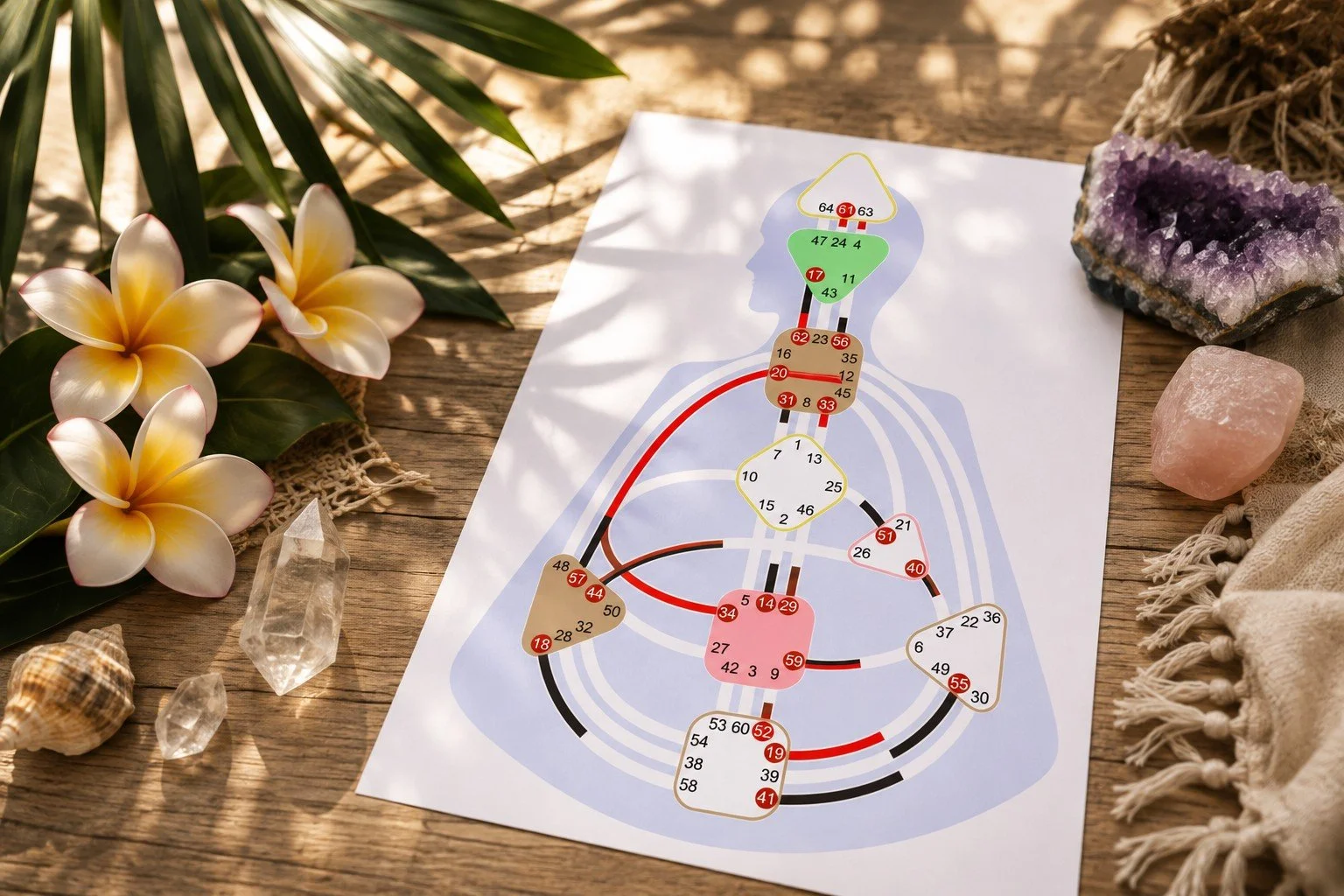
Your Human Design chart, sometimes called a BodyGraph, is calculated using your birth date, birth time, and birth location. At first glance, it can look a little intimidating. There are shapes, lines, numbers, colors, gates, channels, and symbols everywhere.
But you don’t need to understand all of that to begin benefiting from Human Design.
The most useful place to start is with a few foundational pieces: your Type, Strategy, Authority, Profile, Centers, Gates, and Channels. Over time, these pieces begin to reveal a much bigger picture of how you are naturally designed to experience life.
Your Human Design Type
There are five Human Design Types: Manifestor, Generator, Manifesting Generator, Projector, and Reflector.
Your Type describes the general way your energy interacts with the world. Generators and Manifesting Generators, for example, have consistent Sacral energy available for work, creativity, movement, and engagement with life. Projectors are designed differently and tend to thrive when they work with their energy more selectively. Manifestors are naturally equipped to initiate, while Reflectors have a highly receptive design that is deeply influenced by their environment.
None of the Types is better than another. They simply operate differently.
Understanding your Type can be surprisingly freeing because it helps explain why trying to live according to someone else’s energetic rhythm can feel so exhausting.
Strategy: How You’re Designed to Move Through Life
Each Human Design Type has a Strategy. Your Strategy gives you a practical way to interact with opportunities, relationships, decisions, and the world around you.
Generators and Manifesting Generators are designed to respond. Projectors are taught to wait for recognition and invitation in important areas of life. Manifestors are designed to inform before initiating, and Reflectors are encouraged to wait through a lunar cycle before making major decisions.
Strategy isn’t meant to become another rigid set of rules. Think of it more as an experiment. You begin noticing what happens when you stop forcing life to unfold in the way you think it should and start working with the way your energy naturally functions.
Authority: Your Inner Decision-Making Compass
Authority is one of my favorite parts of Human Design because it brings decision-making back to the individual.
Many of us have been taught to make decisions primarily with our minds. We analyze the possibilities, create pros-and-cons lists, ask everyone we know what they think, and try to figure out the “right” answer.
Human Design suggests that your mind isn’t necessarily your most reliable decision-making tool.
Depending on your design, your Authority might guide you through an emotional process, an immediate Sacral response, quiet intuition, or another internal mechanism. Learning your Authority can help you recognize the difference between a decision that comes from your natural inner knowing and one driven by fear, pressure, conditioning, or overthinking.
Your Profile: How You Learn and Experience Life
Your Profile consists of two numbers, such as 1/3, 2/4, 4/6, or 5/1. There are twelve possible Profiles, and each one describes important themes in the way you learn, relate to others, develop wisdom, and move through your life experiences.
Some people are naturally experimental and learn through trial and error. Others need a strong foundation of knowledge before they feel comfortable moving forward. Some require plenty of alone time, while others discover opportunities primarily through their relationships and networks.
Understanding your Profile can help you stop judging qualities that may actually be an important part of your natural way of navigating life.
Defined and Undefined Centers
The nine Centers in a Human Design chart represent different areas of energy and awareness.
Some Centers in your chart may be defined, which means you tend to experience that energy in a relatively consistent way. Others may be undefined or open, meaning you are more receptive to the energy and influence of other people and your environment.
These open areas can become some of our greatest places of wisdom, but they can also be where conditioning happens.
You may find yourself amplifying someone else’s emotions, trying to prove your worth, rushing to escape pressure, or holding onto ideas and identities that aren’t really yours. Human Design helps you begin noticing these patterns without needing to judge them.
Awareness itself can start changing your relationship with them.
Gates, Channels, and the Deeper Layers of Your Design
Once you understand the foundations, you can begin exploring the Gates and Channels in your chart.
The 64 Gates represent specific energetic themes and correspond with the 64 hexagrams of the I Ching. When two connected Gates are activated, they can form a Channel between two Centers. Your defined Channels describe consistent energetic patterns, talents, themes, and ways of processing or expressing energy.
This is where Human Design becomes incredibly individual. Two people may share the same Type and Authority yet have very different charts—and very different experiences of being that Type.
There is always another layer to explore.
Human Design Isn’t About Putting You in a Box
One of the common misunderstandings about Human Design is that it labels you and tells you what you can or cannot do.
I see it very differently.
Human Design can actually help you get out of the boxes you’ve already been placed in.
Throughout life, we absorb messages about who we should be, how hard we should work, how quickly we should make decisions, what success should look like, and what kind of person we need to become.
Human Design gives you another possibility: What if you stopped trying so hard to become who you thought you were supposed to be and became curious about who you already are?
That is where Human Design becomes more than an interesting personality system. It becomes a tool for deconditioning, self-trust, and soul alignment.
Start With Your Own Experiment
If you’re new to Human Design, resist the temptation to learn everything at once. A chart contains an enormous amount of information, and it’s easy to disappear down the Human Design rabbit hole.
Start with your Type, Strategy, and Authority. Learn what they mean, and then watch how they show up in your actual life.
Notice how decisions feel in your body. Notice when you’re forcing something versus allowing yourself to respond naturally. Notice which environments and relationships leave you feeling more like yourself—and which ones seem to pull you away from yourself.
Human Design becomes much more powerful when you live it rather than simply study it. You don’t need a chart to tell you who you are. You already are who you are. Human Design simply gives you a fascinating map for remembering.