Originally published July 2023. Updated August 2026.
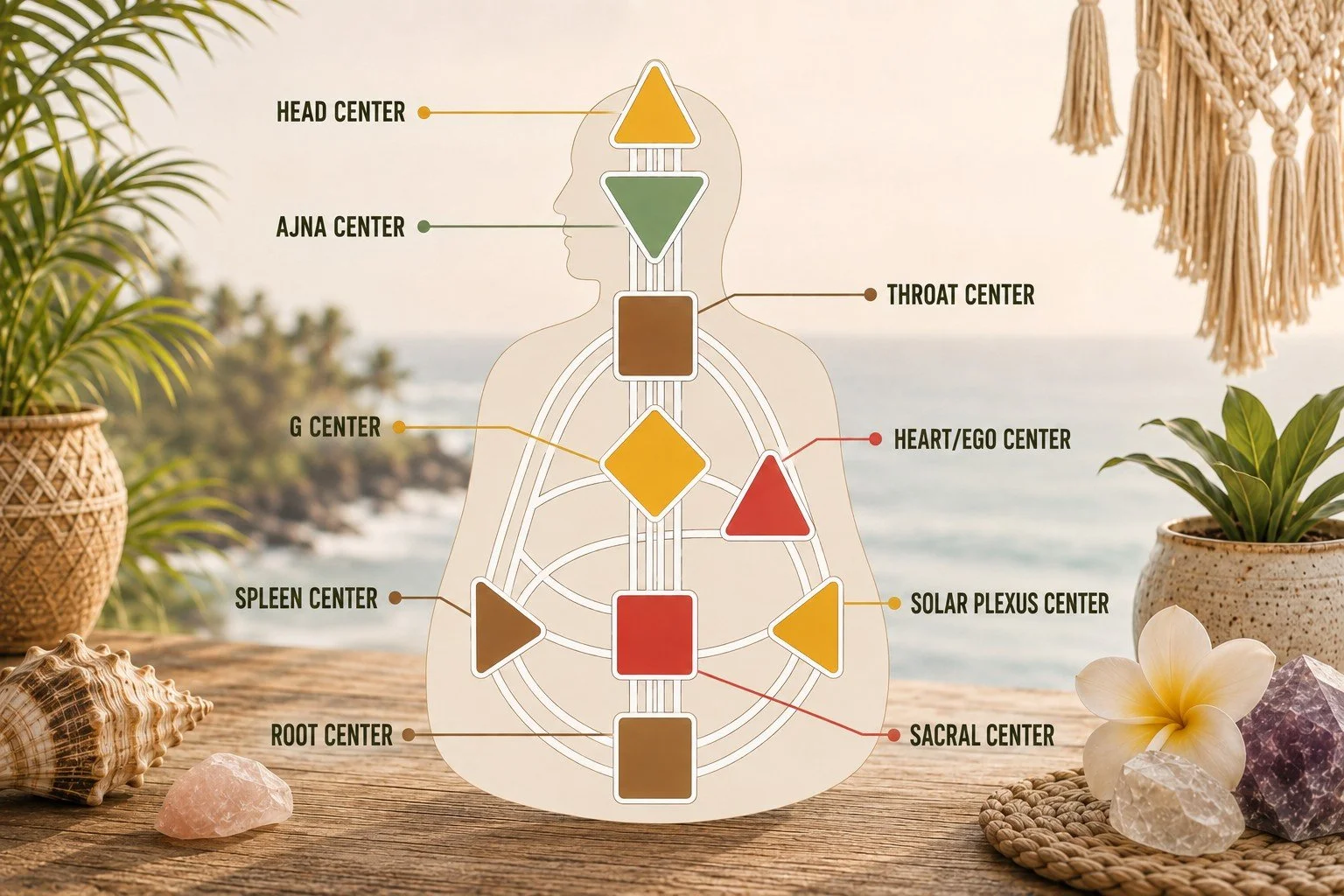
When you first look at a Human Design BodyGraph, your eyes are naturally drawn to the nine geometric shapes connected by lines in the center of the chart. Some may be colored, while others are white. These are the nine Centers, and understanding them can tell you a great deal about how you experience and interact with the world.
The Centers represent different aspects of our energetic functioning—from inspiration, communication, and identity to emotions, intuition, willpower, life-force energy, and pressure.
But perhaps the most interesting thing about the Centers is that they reveal both where your energy tends to be consistent and where you are more open to influence from the people and world around you.
Let’s take a closer look at each one.
Head Center: Inspiration and Mental Pressure
Located at the very top of the BodyGraph, the Head Center is associated with inspiration, questions, ideas, and mental pressure.
When the Head is defined, inspiration tends to operate in a more consistent way. When it is undefined or open, you may experience and amplify the questions and inspiration of people around you.
The challenge can be feeling pressure to think about or answer questions that aren’t actually important to you. An undefined Head can have an endless supply of things to contemplate—which doesn’t mean every thought requires your attention.
One of the great lessons here is learning that you don’t have to figure everything out.
Ajna Center: Thinking and Conceptualization
Directly below the Head is the Ajna Center, which relates to processing information, forming concepts, opinions, and ways of thinking.
A defined Ajna tends to have a more consistent way of processing information. An undefined or open Ajna has greater potential for flexibility, seeing things from different perspectives and experiencing different ways of thinking.
The conditioning challenge of an undefined Ajna can be feeling as though you need to be certain.
But not knowing can be a perfectly valid place to be. Openness here can develop into wisdom about the many different ways something can be understood.
Throat Center: Communication and Manifestation
The Throat is a hub within the Human Design chart because it is where energy moves toward communication, expression, action, and manifestation.
How the Throat operates depends greatly on what it is connected to within an individual chart.
Someone with a defined Throat tends to have a more consistent way of communicating or expressing energy. Someone with an undefined or open Throat may experience pressure to speak, attract attention, or say something simply to be noticed.
The wisdom here can come from discovering that you don’t always need to make something happen with your voice. Sometimes the right words—and the right timing—emerge naturally.
G Center: Identity, Love and Direction
The diamond-shaped G Center sits near the middle of the BodyGraph and is associated with identity, love and direction in life.
A defined G Center generally brings a more consistent experience of identity and direction. Someone with an undefined or open G Center may experience these things more fluidly, sometimes feeling quite different depending on the people and environments around them.
That fluidity doesn’t mean something is missing.
For an undefined G Center, environment can be especially revealing. Rather than forcing yourself to answer Who am I? or Where am I going?, it can be valuable to notice where—and with whom—you feel most naturally yourself.
Heart/Ego Center: Willpower and Worth
The Heart Center, also called the Ego or Will Center, is associated with willpower, value, material resources, promises and self-worth.
With a defined Heart, willpower tends to be available more consistently, although that doesn’t mean it should be used constantly.
With an undefined or open Heart, one of the classic conditioning patterns is feeling the need to prove yourself or demonstrate your worth. You may push yourself to work harder, accomplish more or make promises simply to show that you can.
One of the most freeing realizations for an undefined Heart is that your worth was never something you needed to prove.
Solar Plexus Center: Emotions and Emotional Awareness
The Solar Plexus is the Center of emotions, feelings, sensitivity and emotional awareness.
When it is defined, a person experiences their own emotional wave. Emotional clarity develops over time rather than necessarily being available in the moment.
When the Solar Plexus is undefined or open, you may take in and amplify emotional energy from other people. This can create a tendency to avoid confrontation or uncomfortable truths because another person’s emotional reaction feels so intense.
Learning to recognize which emotions are yours—and which may be amplified through your openness—can bring tremendous awareness.
Sacral Center: Life-Force and Sustainable Energy
The Sacral is the powerful life-force Center associated with work, vitality, sexuality, creativity and sustainable energy.
It is what distinguishes Generators and Manifesting Generators from the non-Sacral Types.
A defined Sacral provides consistent access to this life-force energy, particularly when it is engaged with something that generates a genuine response. An undefined Sacral does not mean someone has no energy. Rather, they are not designed to experience Sacral energy with the same consistency.
One common challenge for an undefined Sacral is not knowing when enough is enough. Because they can amplify Sacral energy around them, they may continue working long after their own system is ready to stop.
Spleen Center: Intuition, Instinct and Well-Being
The Spleen is associated with intuition, instinct, survival, the immune system, health and moment-to-moment awareness.
Splenic awareness is immediate. It doesn’t usually give a lengthy explanation or repeatedly make its case. It can arrive as a quiet instinct, sensation, knowing, taste, smell or intuitive recognition in the present moment.
With a defined Spleen, this awareness operates more consistently. With an undefined or open Spleen, you may be especially sensitive to what feels healthy, safe or unsafe in other people and environments.
A classic conditioning pattern here is holding onto something that isn’t good for you because letting go feels uncertain or frightening.
Root Center: Pressure, Stress and Momentum
At the bottom of the BodyGraph is the Root Center, associated with pressure, stress, adrenaline, momentum and the drive to get things moving.
A defined Root experiences this pressure in a more consistent way. An undefined or open Root can amplify external pressure and may feel compelled to hurry simply to get rid of the uncomfortable feeling of having something left to do.
This can create a familiar cycle: If I can just finish everything, then I can relax.
Except, of course, there is almost always something else to do.
The wisdom of an undefined Root can come from learning that pressure doesn’t always require immediate action.
Defined and Undefined Doesn't Mean Good and Bad
This is one of the most important things to understand about the Centers.
Defined is not better than undefined.
Your defined Centers represent energy that tends to operate consistently within you. They can also be places where your energy influences other people.
Your undefined and open Centers are places where you are more receptive to outside energy and conditioning. But they are also places with tremendous potential for awareness and wisdom.
In other words, the white spaces in your chart aren’t things you need to fix or fill in. They are part of your design.
Your Centers Work Together
Although learning the nine Centers individually is helpful, your BodyGraph is not simply nine separate pieces.
The Centers interact through Channels and Gates, and their meaning changes depending on the unique configuration of your entire chart. Two people can have the same Center defined and experience that energy very differently because of the Channels, Gates, Authority and other elements within their designs.
That’s why Human Design becomes increasingly fascinating as you move beyond individual pieces and begin seeing how the whole chart fits together.
Understanding your Centers is a wonderful place to begin.
Look at which Centers are defined in your chart. Notice which are undefined or completely open. Then, rather than simply memorizing what they mean, start watching how they show up in your everyday life.
Where do you experience consistency? Where do you feel pressure? Where do you seem to amplify other people? Where have you been trying to make yourself consistent when perhaps you were designed to be open?
Human Design becomes most valuable when the chart moves off the page and into your lived experience.
And the nine Centers give you nine fascinating places to begin.