13 Most Common Questions About Human Design
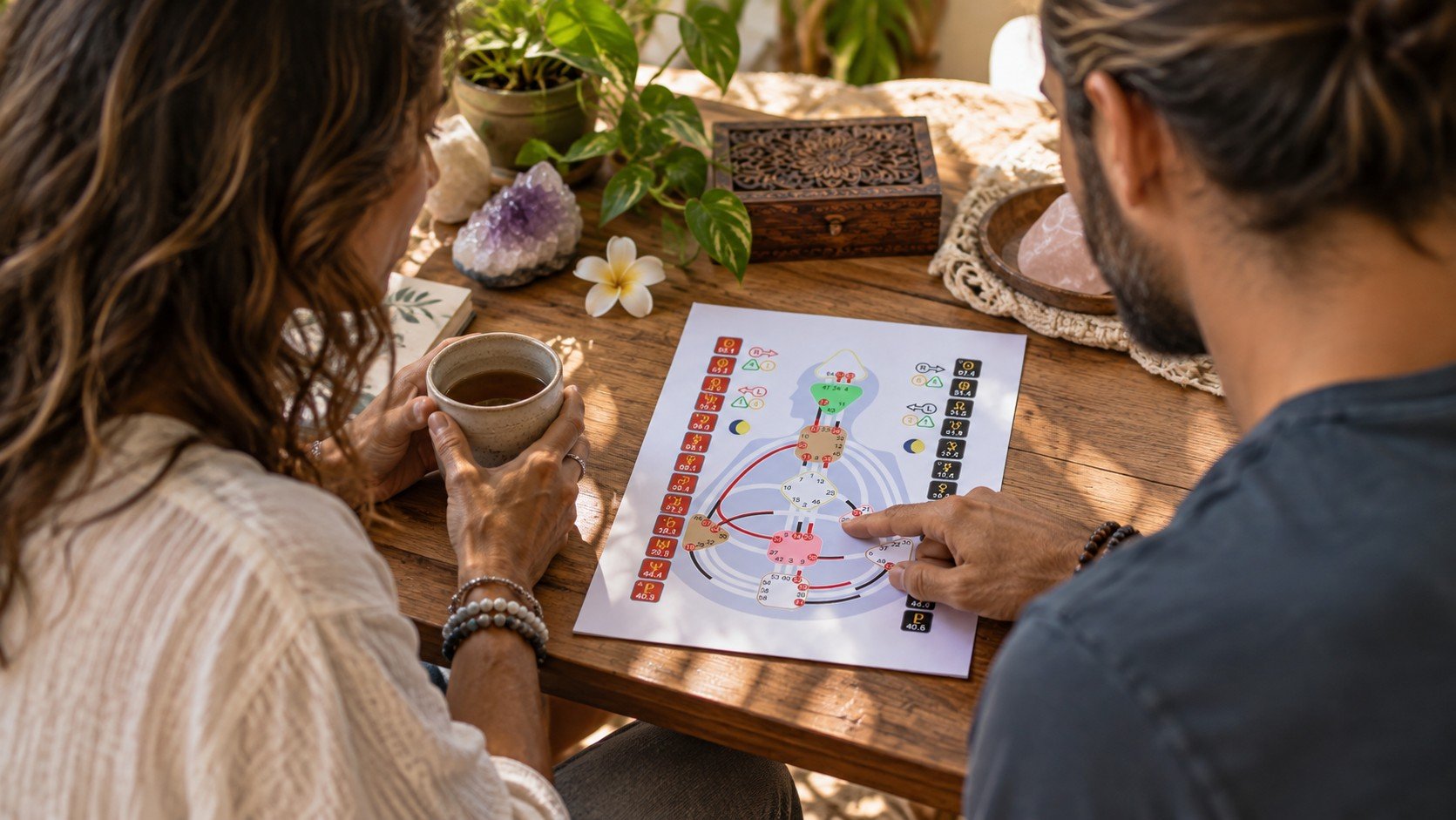
Human Design has a way of creating questions almost as quickly as it answers them.
You discover your Type and immediately want to know about your Authority. Then you notice all those colored and white shapes in your BodyGraph. Before long, you’re wondering about Gates, Channels, Profiles, conditioning, compatibility, and what all of this actually means for your everyday life.
If you’re new to Human Design, you’re not supposed to understand everything at once. It’s a system with many layers, and part of the fun is discovering them over time. Here are some of the questions people commonly ask when they first begin exploring their design.
1. What Is Human Design?
Human Design is a system of self-understanding that uses your birth date, birth time, and birth location to create a personalized energetic blueprint called a BodyGraph.
The system brings together concepts from several ancient traditions—including the I Ching, astrology, the chakra system, and the Kabbalah—alongside modern concepts and terminology. Rather than thinking of your chart as something that defines you, I prefer to see it as a tool for exploring how your energy naturally operates.
2. What Are the Five Human Design Types?
There are five Energy Types: Generator, Manifesting Generator, Projector, Manifestor, and Reflector.
Your Type provides a foundation for understanding how you naturally engage with life. But Type is only one piece of your design. Two people can have the same Type and still have very different charts and experiences.
That’s why learning that you’re a Generator or Projector is the beginning of the exploration, not the end.
3. What Are Strategy and Authority?
Strategy describes how your Type is designed to interact with opportunities and experiences. Authority describes your personal process for making decisions.
Together, Strategy and Authority are often considered the most practical place to begin experimenting with Human Design. Instead of trying to mentally figure out every decision, you begin paying attention to your own internal signals and how life unfolds when you work with your natural energy rather than against it.
4. What Do the Colored and White Centers Mean?
The nine geometric shapes in the BodyGraph are called Centers.
A colored Center is defined, which means its energy tends to operate more consistently within you. A white Center is undefined or open, meaning you may be more receptive to energy and influence in that area.
Neither is better.
Defined Centers can show you where you have energetic consistency, while undefined and open Centers can reveal areas of conditioning as well as opportunities for awareness and wisdom.
5. What Does My Profile Mean?
Your Profile consists of two numbers, such as 1/3, 2/4, 4/6, or 6/2.
It describes themes related to how you learn, relate to others, experience life, and express your role in the world. Many people find their Profile surprisingly validating because it can explain patterns they’ve experienced throughout their lives.
Your Profile doesn’t tell you who you must be. It gives you another perspective from which to recognize yourself.
6. Why Does Human Design Feel So Accurate?
This is one of the questions that draws many people deeper into Human Design.
Sometimes a chart puts language around something you’ve sensed about yourself for years. Perhaps you’ve always needed time before making important decisions, absorbed other people’s emotions, required more rest than those around you, or felt frustrated when trying to make things happen through sheer force.
Seeing those patterns reflected in your chart can create a powerful feeling of recognition.
Human Design may feel less like someone telling you who you are and more like someone giving names to things you already knew somewhere inside yourself.
7. Do I Have to Know My Exact Birth Time?
An accurate birth time is preferable because the chart is calculated using birth information, and some chart details can change as the time changes.
If you don’t know your birth time, look for a birth certificate or other official record if possible. Family members may also remember approximately when you were born, although an estimated time obviously isn’t the same as a documented one.
If you’re working with an uncertain time, it’s helpful to remember that uncertainty when interpreting the chart.
8. Can My Human Design Change?
Your birth chart itself doesn’t change as you grow older.
But the way you experience and express your design certainly can.
You may become more aware of conditioning. You may learn to trust your Authority more deeply. You may stop trying to maintain an identity that never felt natural. Parts of your chart that made little sense when you first saw them may suddenly become obvious several years later.
The chart remains the same. Your relationship with it evolves.
9. Can Human Design Tell Me What Career or Relationship Is Right for Me?
Yes and no.
Human Design won’t necessarily tell you the specific career or job you’re meant to have, but it can reveal the types of work, roles, environments, and ways of using your energy that may be most aligned with your design.
Understanding these patterns can help you recognize work that allows you to use your natural strengths, energy, and gifts rather than trying to fit yourself into a career that doesn’t feel like you.
10. Can Human Design Help with Relationships?
Human Design can be fascinating to explore within relationships because it helps us recognize that other people genuinely may not experience life the way we do.
One person may need time to reach emotional clarity while another knows something instinctively in the moment. One person may have abundant Sacral energy while another doesn’t. Certain Centers may be consistently defined in one person and open in another.
Understanding those differences can create more compassion and less pressure to make everyone operate the same way.
The goal isn’t to determine whether two charts are “good” or “bad” together. It’s to bring greater awareness to the dynamics between two unique people.
11. What Is Conditioning?
Conditioning refers to the ways we can take in and amplify energy from other people and our environment, particularly through our undefined and open Centers.
You might feel pressure to prove your worth, avoid confrontation, hurry, find certainty, or hold onto a particular identity because of conditioning.
That doesn’t mean everything you experience in an open Center is somehow false or bad. Human beings influence one another. The invitation is simply to become aware of what you’re experiencing so you have more choice about what you do with it.
12. Do I Have to Believe in Human Design for It to Work?
No.
In fact, Human Design is much more interesting when approached as an experiment rather than something you must believe.
Learn your Strategy and Authority. Observe your energy. Notice your conditioning. Pay attention to what happens when you make decisions differently. See what resonates with your actual experience and what doesn’t.
You don’t need to accept every Human Design teaching simply because someone says it belongs to your chart.
13. Where Should I Start?
Start simple.
Learn your Type, Strategy, and Authority first. Then begin exploring your defined and undefined Centers and your Profile. Once those foundations feel familiar, you can move into Gates, Channels, Definition, your Incarnation Cross, Variables, and the many deeper layers of Human Design.
There is no prize for understanding your entire chart the fastest. Human Design becomes much more valuable when you give yourself time to actually experience what you’re learning.
Your Chart Is an Invitation to Know Yourself
Perhaps the most important question isn’t What does my Human Design chart say about me?
It’s What am I discovering about myself through this experiment?
Your chart can give you language, insight, and a framework for recognizing patterns that may have been present throughout your life. But it isn’t meant to become another authority outside yourself.
Use Human Design to become more curious about your energy. Notice what feels true. Experiment with what you learn. Trust your own experience.
Because ultimately, the most valuable thing your Human Design chart can help you discover isn’t another label.
It’s you.