10 Common Human Design Mistakes Beginners Make
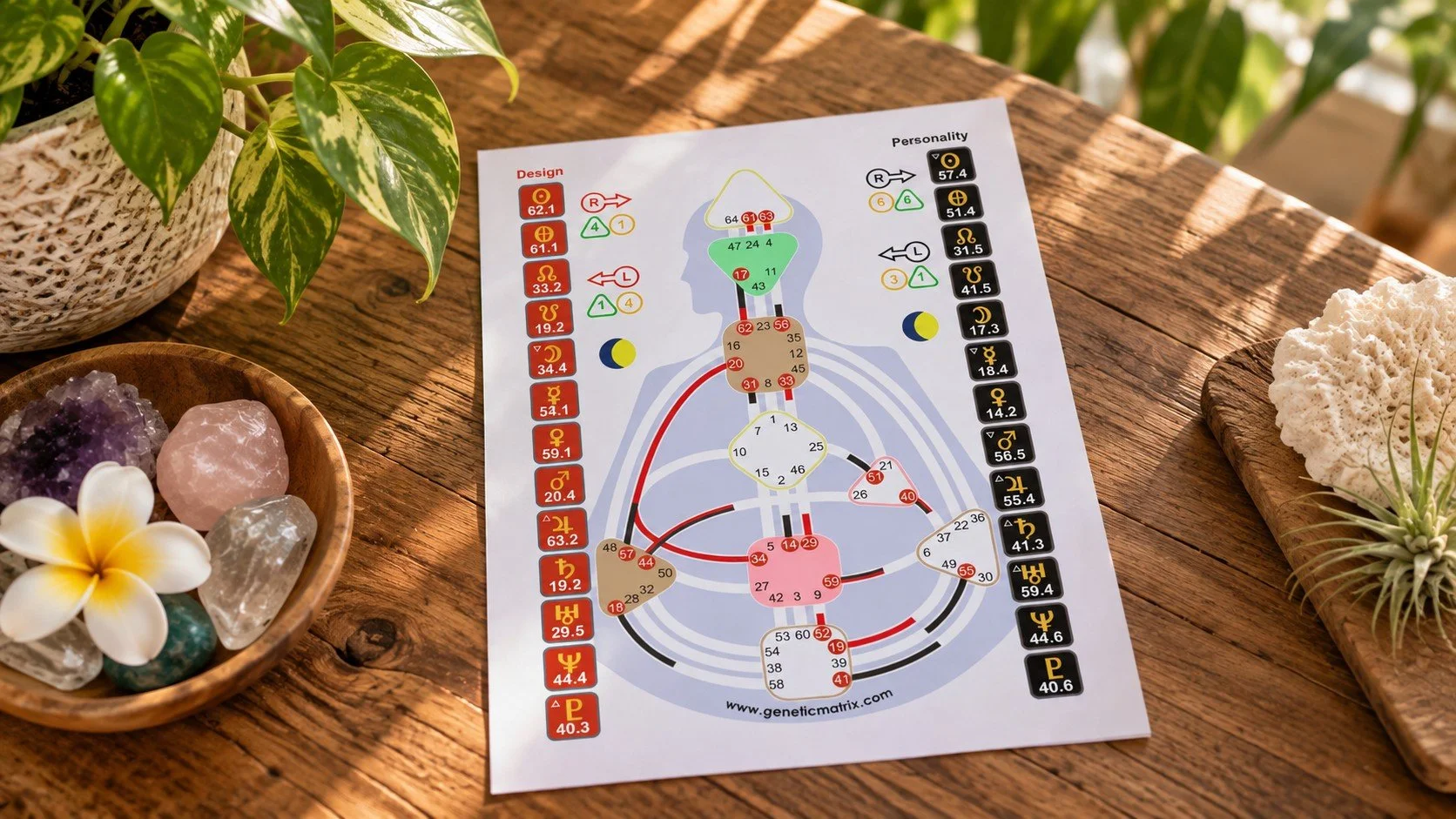
Human Design can feel like discovering an entirely new language for understanding yourself. You calculate your chart, learn your Type, and suddenly there are Centers, Gates, Channels, Profiles, Authorities, Strategies, planetary activations, Variables, and more.
It’s exciting—and it can also be a lot.
When you’re new to Human Design, it’s easy to get caught up in trying to understand everything at once or accidentally turn your design into another set of rules you’re supposed to follow. But Human Design isn’t meant to make life more complicated. It’s meant to help you understand your natural energy so you can live with greater awareness and alignment.
Here are some of the most common mistakes beginners make.
1. Trying to Learn Everything at Once
Once you see how much information is contained within a Human Design chart, you may want to understand all of it immediately. But you really don’t need to.
Start with your Type, Strategy, and Authority. Then explore your Centers and Profile. Those foundational pieces alone can give you plenty to experiment with before you ever dive into Gates, Channels, Variables, or the deeper layers of your chart.
Human Design is something you can explore for years. There’s no need to rush through it.
2. Thinking Your Type Explains Everything
Learning that you’re a Generator, Manifesting Generator, Projector, Manifestor, or Reflector can be incredibly validating. But your Type is only the beginning.
Two people of the same Type can be remarkably different. They may have different Authorities, Profiles, defined Centers, Channels, Gates, and life themes. Their experiences, personalities, conditioning, and environments will also influence how their designs are expressed.
Your Type gives you an important foundation, but it doesn’t define the entirety of who you are.
3. Using Human Design as Another Personality Test
It can be tempting to approach Human Design like a personality quiz: I’m this Type, therefore I behave this way. But Human Design is much more interesting when you treat it as an experiment rather than a collection of labels.
Instead of asking, Does this description sound like me? try asking, What happens when I actually experiment with this?
Follow your Strategy. Notice your Authority. Observe your open Centers. Pay attention to what creates greater ease and what creates resistance. Your lived experience is where Human Design really comes alive.
4. Making Decisions with Your Mind
This may be one of the biggest Human Design mistakes of all. You learn about your Authority—and then continue making every important decision by creating a list of pros and cons, asking five friends what they think, researching for three hours, and trying to mentally predict every possible outcome.
The mind is wonderful for gathering information and considering possibilities. But according to Human Design, it isn’t meant to be your inner decision-making authority.
Learning to recognize your Authority can take practice, especially if you’ve spent most of your life relying on mental reasoning. Give yourself time to discover how your own inner guidance communicates.
5. Turning Strategy and Authority into Rigid Rules
There’s another side to this. Sometimes people become so determined to “do Human Design correctly” that they begin questioning every little thing. Am I responding? Was that really an invitation? Did I inform correctly? Was that my Authority? Am I out of alignment now?
Human Design isn’t meant to make you afraid of making the wrong move. Strategy and Authority are tools for experimentation and self-trust, not rules for achieving Human Design perfection. The goal isn’t to police yourself. It’s to become more aware of how your energy naturally works.
6. Assuming Defined Means Better
When beginners first discover the Centers, it can be easy to look at all those colored shapes and think, Great! I want more of those. But defined Centers aren’t better than undefined or open Centers.
Your defined Centers represent energies that tend to operate more consistently within you. Your undefined and open Centers are places where you are more receptive to outside energy and conditioning—but they can also become incredible sources of wisdom.
The white spaces in your chart aren’t weaknesses. They’re an important part of your design.
7. Using Your Design as an Excuse
Human Design can explain a lot, but it doesn’t have to become an excuse for everything you do.
“I’m a Manifestor, so I can do whatever I want.”
“I’m a Projector, so I shouldn’t have to work.”
“I’m emotionally defined, so everyone just has to deal with my moods.”
That isn’t really the point.
Understanding your design can help you honor your natural energy while also becoming more conscious of how you move through the world. Awareness gives you more choice, not less responsibility.
8. Comparing Your Chart to Someone Else's
Human Design is literally about recognizing that we aren’t all designed the same way—yet it’s surprisingly easy to start comparing charts.
Someone has more defined Centers. Someone has a Channel you wish you had. Someone has an Authority that sounds easier than yours. Someone’s Profile seems more interesting. But there is no “best” Human Design chart.
Your chart isn’t a collection of traits you won or lost in some cosmic lottery. It’s a map of your particular energetic configuration. The real exploration is discovering what it means to live your design.
9. Assuming Every Description Has to Fit
You may read something about your chart and immediately think, That doesn't sound like me at all. That’s okay.
Some aspects of Human Design resonate instantly. Others make more sense after you begin recognizing conditioning or observing yourself over time. And sometimes a particular interpretation simply doesn’t resonate with your experience.
You don’t have to force yourself to fit a description because it appears in a Human Design book or website. Stay curious. Observe. Experiment. Let your own experience matter.
10. Forgetting That You Are More Than Your Chart
Your Human Design chart can reveal fascinating patterns in the way your energy operates, but it isn’t the totality of who you are.
You are still a unique human being with your own experiences, desires, relationships, awareness, creativity, choices, and connection to something greater than yourself.
Human Design should help you feel more like you, not reduce you to a diagram. Use your chart as a tool for self-discovery rather than another identity to squeeze yourself into.
Let Human Design Bring You Back to Yourself
Perhaps the biggest mistake is believing there is a perfect way to live your Human Design. There isn’t.
You’re going to make decisions from your mind sometimes. You’ll recognize conditioning after you’ve already acted on it. You may push when waiting would have felt better, ignore your inner guidance, or forget everything you’ve learned about your chart in the middle of a busy week. That’s part of the experiment.
Human Design isn’t about getting yourself right. It’s about becoming more aware of your own energy, noticing what feels aligned, recognizing what doesn’t, and gradually trusting yourself more deeply.
Learn your design. Experiment with it. Stay curious. And most importantly, let it give you greater permission to be yourself—not another reason to believe you should be doing life differently.